
Al Hoceima National Park, North Morocco

Updated: Jul 16
Richard Hammond visits Al Hoceima National Park in the north of Morocco and discovers an off-the-beaten-track land rich in natural and cultural heritage that is gearing up to welcome international ecotourists.
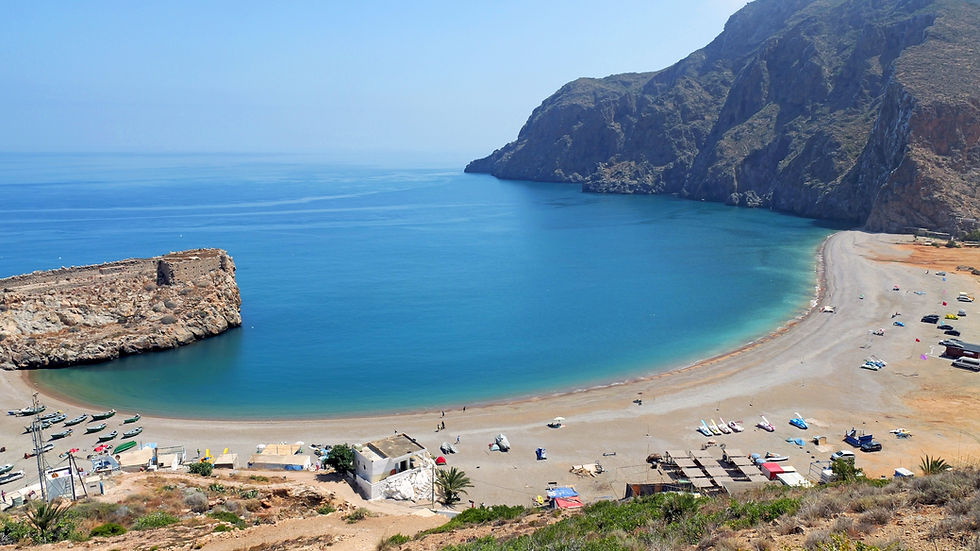
Our two-hour hike along a sandy path, at times rocky and canyon-like through a bone-dry riverbed valley, eventually led to a beautiful, isolated beach fringed by high cliffs. We passed ancient stone dwellings, including an abandoned mosque, and the woody balsamic scent of pine trees on high craggy cliffs occasionally wafted through the salty sea air. Our local guide, Hasssan Ettaoussi, explained how the evergreen drought-resistant carob tree thrives in this unique ecosystem that endures long dry summers. Hasssan also encouraged us to keep an eye out for birds of prey – particularly eagles and endangered ospreys – and at one point we did glimpse a pair of eagles soaring high above the valley. Despite the heat (temperatures were in the mid-thirties) and humidity, this was a beach well worth the walk. On arrival at the secluded pebbly cove, we all immediately peeled off our packs and plunged into the cool turquoise sea.

I’d come to Al Hoceima National Park in the northeast of Morocco, a 480-square kilometre (185 square-mile) protected area between the Rif Mountains and Mediterranean Sea about 20 kilometres (14 miles) to the west of the eponymous city, Al Hoceima on the coast. The national park’s dual coastal and inland habitats make it an important site for conservation – it is home to several rare and endangered species listed on the IUCN Red List, including a significant red coral reserve and diverse marine life including key fish species and invertebrates.
Little-known outside of Morocco and Spain, there are no direct flights to this part of Morocco from the UK, the only access is via flights to Nador-Al Aaroui International Airport (from where it’s a 90-minute drive to Al Hoceima) from Spain (Barcelona, Madrid and Murcia) or from Amsterdam, or by ferries run by Naviera Armas from Motril in southern Spain to Al Hoceima port (a journey of about 5 hours) that run from July to September.

Timeless traditions
I’ve visited most of Morocco’s main cities and have trekked in the Atlas Mountains, but here in the north of the country, close to the border with Algeria, felt like another world –a place where age-old customs, sounds and traditions still dominate the working day – we saw countless men and women walking back from their fields with donkeys laden with hay, simple food and shared music are the focus, days were ushered in with the early morning call of cockerels, and the call to prayer was broadcast from local mosque minarets five times a day.
On this trip, I was part of a small group of visitors eager to learn more about what this little-known part of Morocco had to offer the burgeoning ecotourism market. Earlier that morning at the park’s Environmental and Information Centre, Hassan, who was born in Targuist a small town about 70 km from Al Hoceima in the heart of the Rif Mountains, gave us an introduction into the varied flora and fauna of the National Park and explained how both the natural and cultural heritage of the park provided the potential for developing nature-led community based eco-tourism. Over the coming days, he introduced us to a variety of experiences in the National Park that focused on nature conservation but also included a series of community-led experiences to give us a taste of what ecotourists could expect in this remote part of North Africa.

Watch the video of the trip:
Video filmed and produced for IUCN by Richard Hammond, a Green Traveller Media production
Power to the People
The first community-led experience we were taken to was a workshop at the handicraft centre in Rouadi, about 30km southwest of Al Hoceima city. The Rouadi women’s cooperative provides workshops on traditional Rif Berber artisanry including basket-weaving, clay pottery and bread making. Later in the visit, we went to a second cooperative – Nissae Bades – housed in a wooden hut on the beach at Bades, where we learnt from about a dozen women how to weave straw and coloured rope. Both cooperatives support women who would otherwise be making these kinds of crafts in isolation at home. Hassan explained that by bringing them together as a part of a shared cooperative, they can earn from each other and earn an alternative income for their families – many of their husbands work in seasonal agriculture where guaranteed income can be precarious.

Riffian hospitality
Throughout the trip, we stayed at Thaddart Tamakrant guesthouse in Adouz – a traditional Riffian Berber village on a high limestone vantage point about 600 metres above sea level in the Bokkoya massif, about 12 km from Rouadi. The rooms were simple and unfussy, just like the food that featured classic Rif dishes, such as grilled chicken and fish stew seasoned with saffron and peppers. At breakfast, we were served delicious bread made by a woman from the village (on an open fire just outside the guesthouse), tortilla, poached eggs, pancakes, honey, strawberry jam, and a sweet nutty sauce made from roasted almonds and argan oil. All washed down with strong coffee or the readily available mint tea.
Nights at the guesthouse were filled with music – on one night we danced on the street outside to the wonderful rhythms of hand-made drums and traditional reed oboes played by a group of men dressed in burgundy robes, while on another night, we were entertained inside the guesthouse by a local band playing guitars and singing melodic and soulful Berber songs into the night.

The trail to Torres
On our second day, we hiked the coastal trail in the west of the National Park from Bades to Torres. Bades bay is a huge sweep of a beach dramatically flanked at its eastern end by the Rif mountains. Here you can hire kayaks and go on boat tours or just chill out on the beach and enjoy the sheltered turquoise waters. Adjacent to the bay across to a small isthmus is Peñón de Vélez de la Gomera, a Spanish military base, surely one of the most picturesque military bases in the world. It’s one of several Plazas de Soberanía ("strongholds of sovereignty”) – Spanish territories that are scattered along the Mediterranean coast bordering Morocco.

From Bades, we walked along a scenic 6-kilometre (3.7-miles) coastal trail to the village of Torres, which is about 37km (23 miles) west of Al Hoceima. About halfway along the trail, we started to get glimpses of the magnificent Qal’ at Torres – an ancient fort perched high above the village that is protected as an historic monument as a testament to the importance of the central and western Rif from the introduction of Islam until the 15th Century. Six fortified towers reinforce the central enclosure, four at the corners, one framing the impressive arched entrance door, and the sixth housed canons intended to defend the entrance to the Beni Boufrah wadi.

Down from the fort away from the village is a beach known as the ‘beach of seven doors’ that refers to the seven entrances to a cave just each of the beach. Hassan took us round to the cave at low tide to show us the entrances of this magnificent cave.

Lunch with a view
We took lunch one day at the Jbel Bourfiee guesthouse in the village of Taounil within the Rouadi commune that sits in an exquisite setting high up with stellar views over a dry river valley and the rugged terrain of the Rif mountains. We feasted on grilled sardines, anchovies, lentils, fresh salad and a dish called Bissara, a traditional Moroccan dish made mainly from dried fava beans drizzled with olive oil and ground cumin. It was a sumptuous lunch in a superb setting; some of our group were tempted to stay here for the night and enjoy more of the wonderful hospitality and the night skies from this high vantage point far from the lights of any city.


Souks and Seafood
On our final morning, we visited the picturesque market at Raoudi where brightly coloured stalls are framed by the surrounding hills. Here small-scale farmers and growers bring their wares to sell on a Sunday, selling everything from spices, fruit and veg to clothing and household goods. We then drove to Al Hoceima port to go on a boat trip out along the picturesque coastline of rocky outcrops and steep cliffs and around three Spanish islands just off the coast. We stopped off in a secluded spot and snorkelled in the warm turquoise waters. On our return we selected the seafood we wanted (monk fish, calamari, sardines, and shrimps) for lunch from the fishmongers in the harbour-side outdoor fish market who took it to one of the restaurants to be cooked and prepared for us. It was a fabulous way to end the trip – cracking open the freshest seafood crustacea with our hands, a timeless activity like so much of what we experienced in this age-old part of North Africa.

==
Disclosure: Richard was a guest of IUCN Med, the Blue Mediterranean League for Youth as part of the Blue Tourism Initiative under which this ecotourism experience was developed using the MEET methodology. Richard had full editorial control of this feature, which has been written in his own words based on his experience of visiting Al Hoceima in June 2026. All opinions are the author’s own.


Comments